Planning
Website, web app or mobile app?
Three products that are easy to confuse. Here is how to tell which one your business needs first.
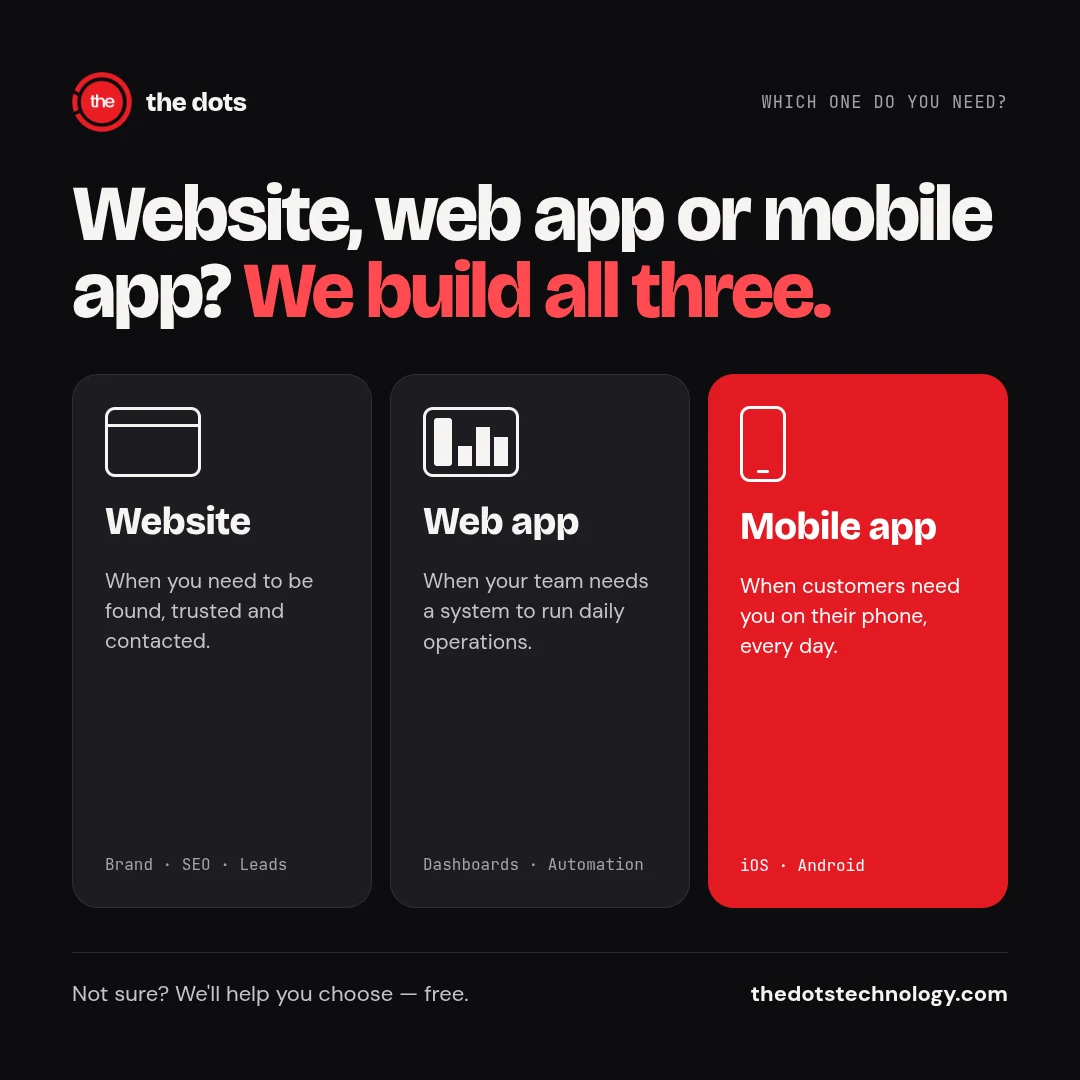
Many projects start with "we need an app". Often that is right. Sometimes a website would do the job for a fraction of the cost. The question to ask is not which technology is best, but what your customers and staff need to do.
Choose a website when people need to find and trust you
A website is your public front door. It explains what you do, shows up on Google and turns visitors into enquiries. If most of your goal is to be found, look credible and receive messages, this is where to start.
- Customers search for you before they buy
- You mostly share information: services, prices, tours, contact details
- You want enquiries and bookings to arrive in one place
Choose a web app when people need to log in and get work done
A web app runs in the browser but behaves like software. Users have accounts, data is saved, and different people see different things. Booking systems, school management systems and internal dashboards are all web apps. Nothing needs installing, which makes them easy to roll out across a team.
- Staff or customers need their own accounts
- You are replacing spreadsheets, paper or a chain of WhatsApp messages
- Managers need live reports
Choose a mobile app when the phone itself is part of the job
A mobile app earns its place when people use it often, or when it needs the phone's hardware: location, camera, push notifications or working offline. If people will only use it once or twice a year, a good mobile website is usually the better choice.
- Customers come back weekly or daily
- You need notifications, location or the camera
- Field staff work where the network drops out
Often the answer is more than one
A safari operator might need a public website for search, a web app for the office team and a simple mobile app for drivers. All three can share one backend, so a booking made on the website shows up everywhere. You do not have to build them all at once. Start with the piece that removes your biggest bottleneck, and make sure it can connect to the next one.
About the author
David G
Writing at The Dots Technology about software, search, analytics and practical AI for business.
Connect on LinkedInPut this into practice
See how we approach the work, with an interactive walkthrough and a clear delivery plan.